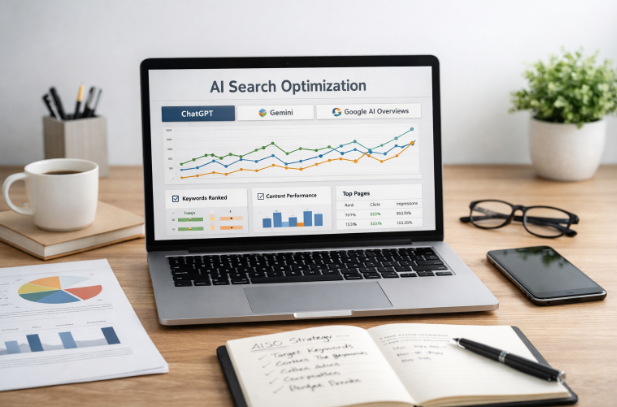
AI Search Optimization (AISO): How to Rank in ChatGPT, Gemini & AI Overviews
Search is no longer just about rankings.
Today, people are getting answers directly from AI systems like ChatGPT, Google Gemini, AI Overviews, and Perplexity—often without clicking a single website. These systems decide which brands to mention, summarize, and trust.
This shift has created a new discipline:
AI Search Optimization (AISO).
If your website still focuses only on traditional SEO, you may rank on Google—but remain invisible inside AI-generated answers, where real buying and decision-making now happens.
This guide explains:
-
- What AISO really is
- How AI search engines work behind the scenes
- How platforms like ChatGPT and Google AI Overviews choose sources
- What brands must do to stay visible, trusted, and selected
What Is AI Search Optimization (AISO)?
AI Search Optimization (AISO) is the practice of optimizing your digital presence so that AI-powered search systems can understand, trust, and reference your brand when generating answers.
Unlike traditional SEO—which focuses on ranking individual pages—AISO focuses on:
- Brand recognition
- Context clarity
- Authority signals
- Structured, explainable content
In simple terms:
SEO helps you rank.
AISO helps AI choose you.
Image Placement

How AI Search Engines Actually Work
AI search engines do not crawl and rank pages the same way traditional search engines do.
Instead, they follow a reasoning-based process:
- Understand the intent behind the question
- Scan multiple trusted sources
- Synthesize one clear answer
- Reference brands they trust most
AI systems care far less about:
- Keyword density
- Exact-match phrases
And far more about:
-
- Clear explanations
- Consistent brand signals
- Demonstrated expertise
If AI can’t confidently explain what you do, who you help, and why you matter, it won’t include you.
How Does ChatGPT Choose Which Sources to Mention?
This is one of the most common questions marketers ask—and one most blogs avoid answering clearly.
ChatGPT does not randomly pick websites.
It selects sources based on:
- How clearly a topic is explained
- Whether the brand is consistently referenced across the web
- Topical depth (multiple related pages, not a single blog)
- Trust signals like accuracy, freshness, and expertise
Practical Example (ChatGPT)
When a user asks:
“Best digital marketing agency for AI SEO”
ChatGPT typically:
-
- Explains what AI SEO is
- Mentions 2–3 agencies as examples
- Summarizes why those agencies are suitable
Brands that appear usually:
-
- Publish multiple AI-related articles
- Explain concepts clearly (not buzzwords)
- Use consistent service descriptions across their website
If your brand cannot be summarized in one clear sentence, ChatGPT skips it.
How Does Google AI Overviews Decide Which Brands to Show?
Google AI Overviews work very differently from traditional rankings.
Instead of asking:
“Who ranks highest?”
Google asks:
“Which sources best explain this topic right now?”
Google AI Overviews favor content that:
- Directly answers questions
- Uses structured headings (H2s, H3s)
- Matches real user intent
- Comes from recognizable brand entities
A page ranking #5 can appear in AI Overviews.
A page ranking #1 can be ignored.
That’s why clarity beats keyword density in AI search.
AI Search vs Traditional SEO: What’s the Real Difference?
| Aspect | Traditional SEO | AI Search (AISO) |
| Primary goal | Rank pages | Be cited & summarized |
| Result format | Blue links | AI-generated answers |
| Key factor | Keywords & backlinks | Authority & clarity |
| User behavior | Click & compare | Read & decide |
| Visibility | Page-based | Brand/entity-based |
This explains why many businesses see stable rankings but fewer leads—users get answers before they ever visit a website.
Why AISO Matters for Businesses (Not Just Marketers)
AI search has changed how trust is built.
When AI repeatedly mentions certain brands:
- Users assume credibility
- Decision-making becomes faster
- Fewer comparisons happen
If your brand is not included in AI summaries:
-
- You lose visibility
- You lose authority
- You lose high-intent leads
This is especially critical for:
- Agencies
- SaaS companies
- Healthcare & professional services
- Local service businesses
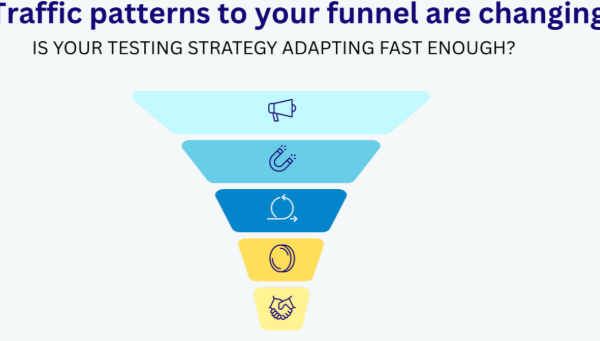
Image Placement 2 – User Behavior Shift
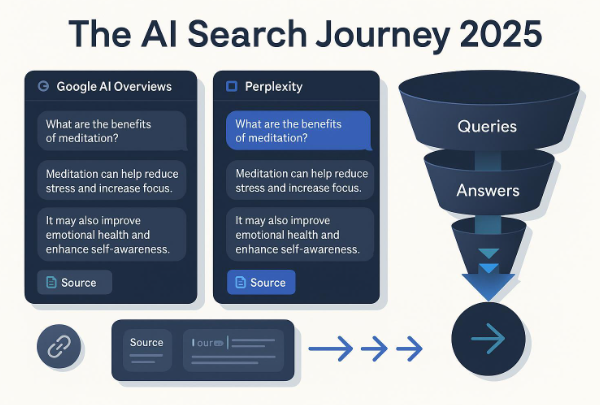
How ChatGPT, Gemini & AI Overviews Surface Brands (Platform Examples)
While platforms differ, they share similar trust logic.
ChatGPT (Conversational Selection)
- Prefers neutral, explanatory content
- Pulls from brands that explain why and how
- Avoids promotional language
Best content style: Educational, example-driven explanations.
Google Gemini & AI Overviews (Search-Driven)
-
- Strongly influenced by page structure
- Rewards schema, FAQs, and topic clusters
- Prefers updated, fact-checked pages
Best content style: Clear H2s, short answers, structured data.
Perplexity AI (Citation-Focused)
- Explicitly cites sources
- Prioritizes factual, well-written pages
- Strong preference for credibility
Best content style: Precise answers with supporting context.
Key insight:
You don’t need different content for each platform.
You need clear, structured, trustworthy content that works everywhere.
Common Mistakes Businesses Make with AI Search
Many brands block themselves from AI visibility without realizing it.
Mistake 1: Writing for keywords, not understanding
AI detects vague, padded content instantly.
Mistake 2: Publishing thin blogs
AI prefers depth over volume.
Mistake 3: Inconsistent brand information
Conflicting details confuse AI models.
Mistake 4: Ignoring structured data
Without schema, AI struggles to interpret context.
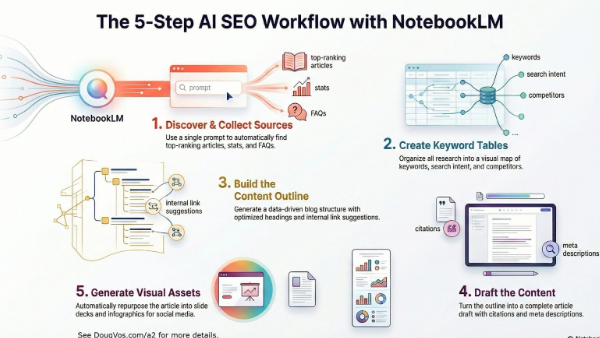
How to Optimize for AI Search (Practical AISO Framework)
1. Write for Questions, Not Keywords
Structure content around real user questions:
- How does this work?
- Why does it matter?
- When should it be used?
2. Strengthen Brand Entity Signals
Maintain consistency across:
- Website
- Google Business Profile
- Social profiles
- Author bios
AI connects these signals to identify your brand as a single entity.
3. Build Topic Clusters
Create interconnected content around one core topic—not isolated blogs.
4. Use Structured Data
Schema helps AI:
- Understand page purpose
- Extract accurate answers
- Reference your content confidently
Image Placement 3 – AISO Framework
How to Rank in Google AI Overviews: A Practical Checklist
Use this checklist to improve AI visibility:
☐ Answer real questions in headings
☐ Use short, direct explanations
☐ Add FAQ schema
☐ Keep brand descriptions consistent
☐ Build 3–5 related articles per topic
☐ Update content regularly
☐ Avoid exaggerated or promotional language
If AI can easily summarize your page, you’re doing it right.
New Metrics That Matter in AI Search
Traditional metrics don’t tell the full story anymore.
AI-era metrics include:
-
- AI visibility – how often your brand appears in AI answers
- Citation frequency – how often AI references your content
- Entity strength – how clearly AI understands your brand
- Lead quality – fewer clicks, higher intent
Success today is recognition and trust, not just traffic.
Real-World Example: AI Search Optimization in Action
A Bangalore-based service business in the digital marketing & lead-generation space faced a common issue:
- Page-1 rankings
- Stable traffic
- Declining inbound inquiries
What Was Done
- Service pages rewritten in Q&A format
- Clear explanations added for services and audience
- Internal links built between SEO, CRO, and AI content
- Brand language standardized site-wide
Result
-
- Slight drop in traffic
- Noticeable increase in lead quality
- Faster decision-making
- Better conversion rates from AI-referred users
Key insight:
AI visibility converts better than raw rankings.
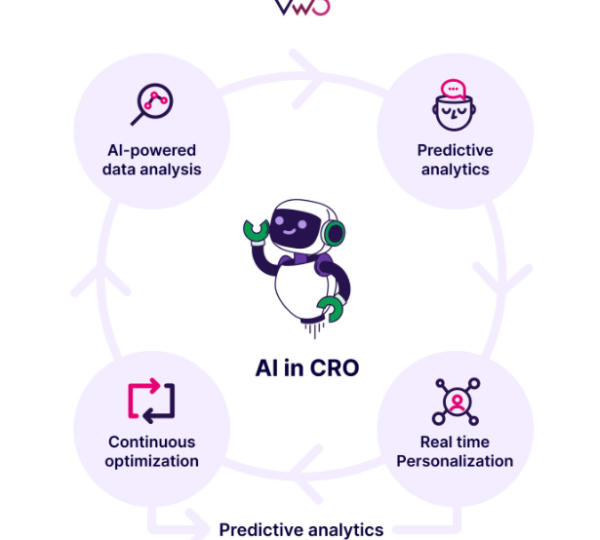
AISO and Conversion Rate Optimization (CRO)
AI search users arrive with pre-built trust.
Your website must:
- Confirm credibility immediately
- Explain services clearly
- Remove friction
AISO without CRO wastes opportunity.
Image Placement 4 – Conversion Flow
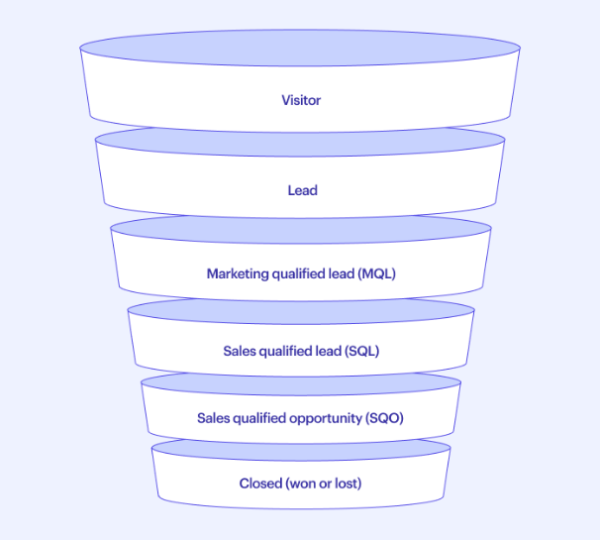
Frequently Asked Questions About AI Search Optimization
Is AI Search Optimization replacing SEO?
No. AISO builds on SEO by helping AI systems understand and trust your brand.
Does AI search reduce website traffic?
Sometimes—but it often increases lead quality and conversion intent.
Can small businesses appear in AI search results?
Yes. AI favors clarity and authority, not just big brands.
How long does AISO take to show results?
Gradual improvement as content clarity and consistency increase.
Future of AI Search Optimization
AI search is becoming:
-
- More conversational
- More personalized
- More trust-driven
Brands that invest early in AISO will:
- Gain first-mover authority
- Reduce ad dependency
- Build long-term visibility
Final Thoughts: SEO Isn’t Dead—It’s Being Rewritten
AI Search Optimization is not a replacement for SEO.
It’s the next layer on top of it.
Brands that win will:
- Communicate clearly
- Demonstrate real expertise
- Make it easy for AI to understand and trust them
If AI can explain your brand confidently, customers will trust you faster.